

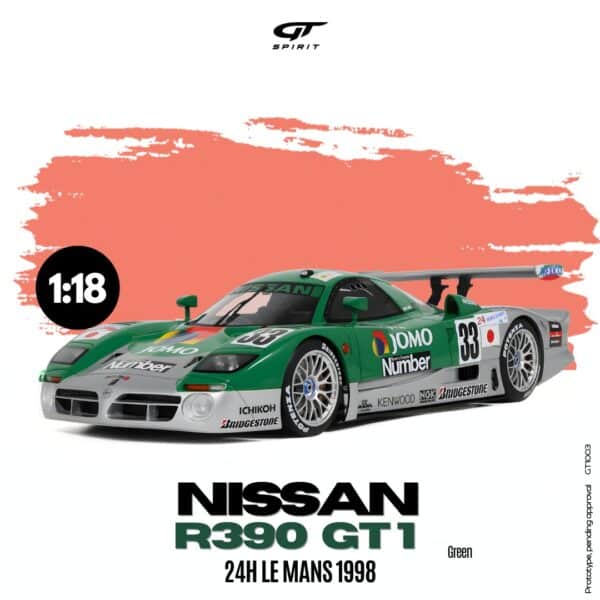

GT Spirit – 1:18 Nissan R390 GT1 Le Mans 1998 Green 1998 – Resin Model
- High-quality handmade resin model
- Dimensions: L 26cm x W 11cm x H 7cm (approx.)
- Individually numbered limited edition
- Officially licensed
About this Model
The GT Spirit 1:18 Nissan R390 GT1 Le Mans Green 1998 represents the pinnacle of resin model craftsmanship. This 1:18 scale masterpiece captures the ultimate Nissan supercar that achieved the marque’s most successful Le Mans result—3rd place overall in 1998, with four cars finishing in the top ten, forged in Britain by Tom Walkinshaw Racing.
Model Specifications
- Scale: 1:18 (Approximately 25cm length)
- Material: High-quality hand-finished resin
- Colour: Green Le Mans livery
- Edition: Individually numbered limited edition
- Licensing: Officially licensed by Nissan
Collector Notes
- Ian Callum-designed bodywork from TWR Design
- VRH35L twin-turbo V8 producing 641bhp race spec
- 1998 Le Mans podium finisher—3rd overall
- Long-tail carbon fiber aerodynamic specification
- Individually numbered limited edition
- Engine design later sold to McLaren for supercars
- Hand-finished resin construction captures every subtle detail
The Real Machine
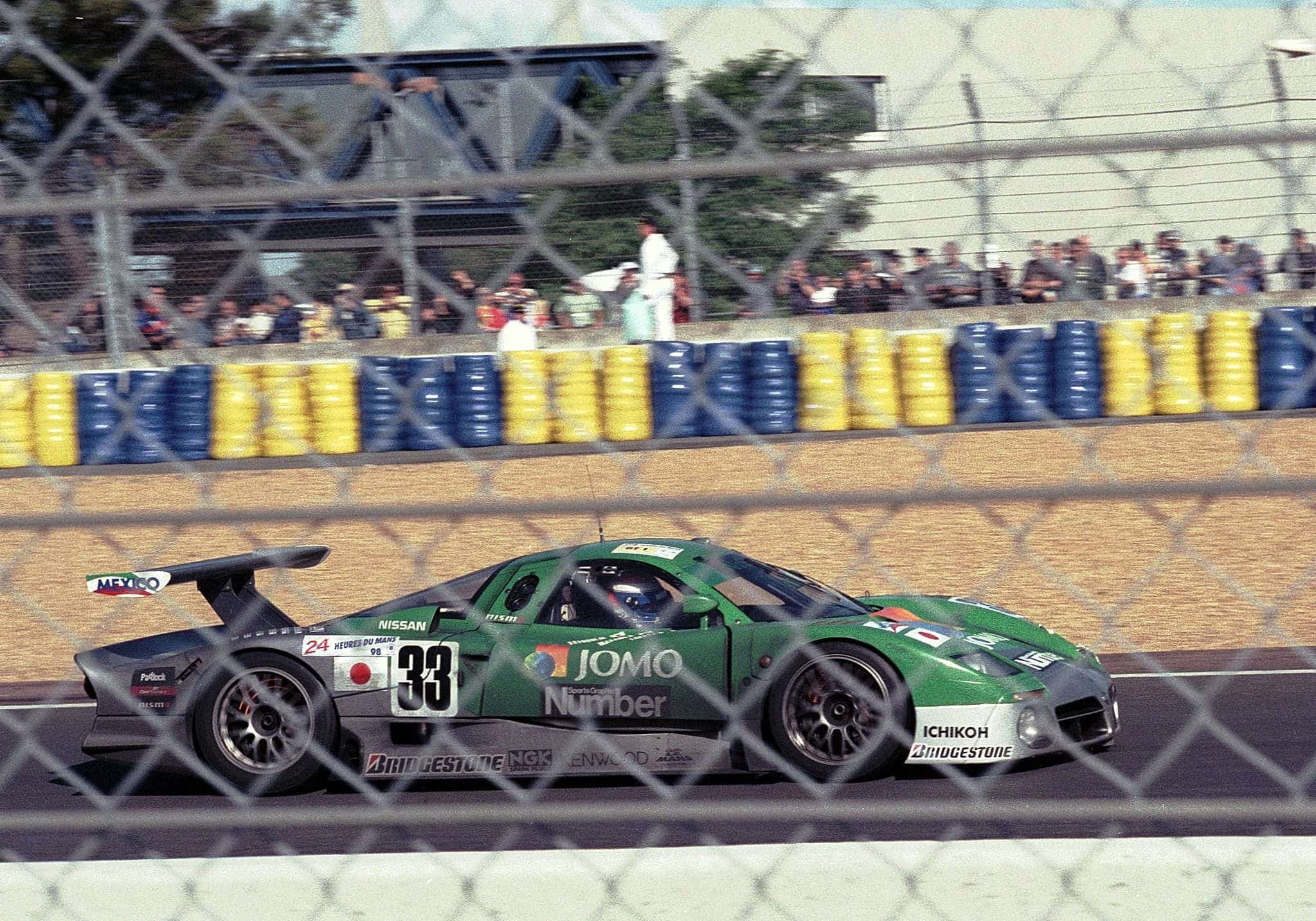
The Godzilla Hunter: Unpacking the Legend of the Nissan R390 GT1
For British enthusiasts, the late 1990s Le Mans GT1 era represents a glorious golden age where manufacturers unleashed hyper-prototypes masquerading as road cars. Among these titans stood a striking mid-engined challenger, forged in the UK and wearing the badge of Japanese reliability: the Nissan R390 GT1.
The R390 GT1 emerged from Nissan’s partnership with legendary British firm Tom Walkinshaw Racing (TWR), known for Le Mans victories with Jaguar. Developed for GT1 class regulations requiring street-legal versions, Nissan embraced the spirit by building the road car first, unlike competitors.
The R390 GT1 became the fastest and most expensive road car ever developed by Nissan. While campaigning only for 1997 and 1998 Le Mans races, its impact was immense, achieving Nissan’s most successful Le Mans result to date.
The heart is Nissan’s VRH35L twin-turbocharged 3.5-litre V8, rooted in Group C era racing. Race trim produced 650 PS (641 bhp) at 6800rpm, while the street-legal version was rated at 549.9 bhp.
Performance was staggering: 0-100 km/h under 4.0 seconds, with 0-60mph in approximately 3.3-3.9 seconds. Top speed reached 354 km/h (220 mph). Power went through an Xtrac six-speed sequential gearbox to the rear wheels.
The stunning form was penned by Ian Callum at TWR Design, incorporating family features like 300ZX headlamps and twin front grilles. Underneath lay an all-carbon fibre monocoque based on the Jaguar XJR-15.
The 1998 specification introduced a long-tail carbon fibre shape, extending length by 13 centimeters. This aerodynamic refinement, honed through extensive wind-tunnel testing, improved airflow and addressed previous cooling issues.
The road car featured launch control and traction control limiting fuel to individual cylinders when detecting wheelspin. Suspension utilized upper and lower A-arms with coil springs, inboard shock absorbers, and anti-roll bars.
Stopping power came from massive AP 14-inch vented disc brakes with six-piston calipers and ABS. The combination of advanced chassis technology and aerodynamics enabled the R390 to compete with purpose-built prototypes.
While primarily a race machine, the road car included standard road appliances, full instrumentation, and leather-covered racing seats. The competition lineage showed through the short-throw sequential gear lever and tiny racing steering wheel.
The intent was extreme performance without compromising street driveability. One restored race car required door panels, glass windshield, and minimal upholstery just to comply with road regulations, showcasing how close the original was to a bare prototype.
The 1998 race was the program’s redemption. The updated long-tail R390 GT1 achieved Nissan’s most successful Le Mans result, securing 3rd place overall and capturing four of the top ten spots (3rd, 5th, 6th, and 10th).
The R390’s legacy extends beyond racing—the VRH engine design was sold to McLaren, becoming the basis for their M838T and M840T engines in models like the MP4-12C and 720S. Its Gran Turismo appearances cemented its status as a gaming icon.
Specifications & Performance Data
| Specification | Value | Notable Facts |
|---|---|---|
| Years Raced | 1997-1998 | GT1 class era |
| Designer | Ian Callum (TWR) | Also designed DB7 |
| Chassis | Carbon fibre monocoque | Based on XJR-15 |
| Engine | VRH35L Twin-Turbo V8 | 3.5L, mid-mounted |
| Power (Race) | 641 bhp @ 6800rpm | 650 PS output |
| Power (Road) | 549.9 bhp @ 6800rpm | 410.1 kW |
| Torque | 470 lb-ft @ 4400rpm | 637.2 Nm |
| Transmission | Xtrac 6-speed sequential | Rear-wheel drive |
| Weight | 1098 kg | 2420 lbs |
| 0-60 mph | ~3.9 seconds | Sub-4 second car |
| Top Speed | 220 mph | 354 km/h |
| Le Mans 1998 | 3rd overall | 4 cars in top 10 |
Pre-Order & Delivery Info
When will it ship?
Do I pay now or later?
Can I cancel my pre-order?
Where do you ship?
Is this a limited edition?
Limited Availability Notice
This pre-order allocation is limited. Once filled, no additional units will be available until general release (if any remain).
Pre-Order Benefits
Why Pre-Order Now?
Guaranteed Allocation – Secure your model before general release
Pre-Order Price Protection – Lock in today’s price, regardless of future increases
Priority Shipping – First to ship when stock arrives
Payment Flexibility – Charged only upon dispatch (June 2026)
Cancellation Option – Full refund available until shipping begins
Join Our Collector Community
Stay Updated: Join our Collectors Club for exclusive previews and collector updates. It’s free and easy to sign up just enter your name and email at the foot of this page.
Model Universe – the UK’s most trusted destination for premium diecast and resin models since 2020